
**Premium Fonts for Logos, Posters, Branding & More — Start Creating.**
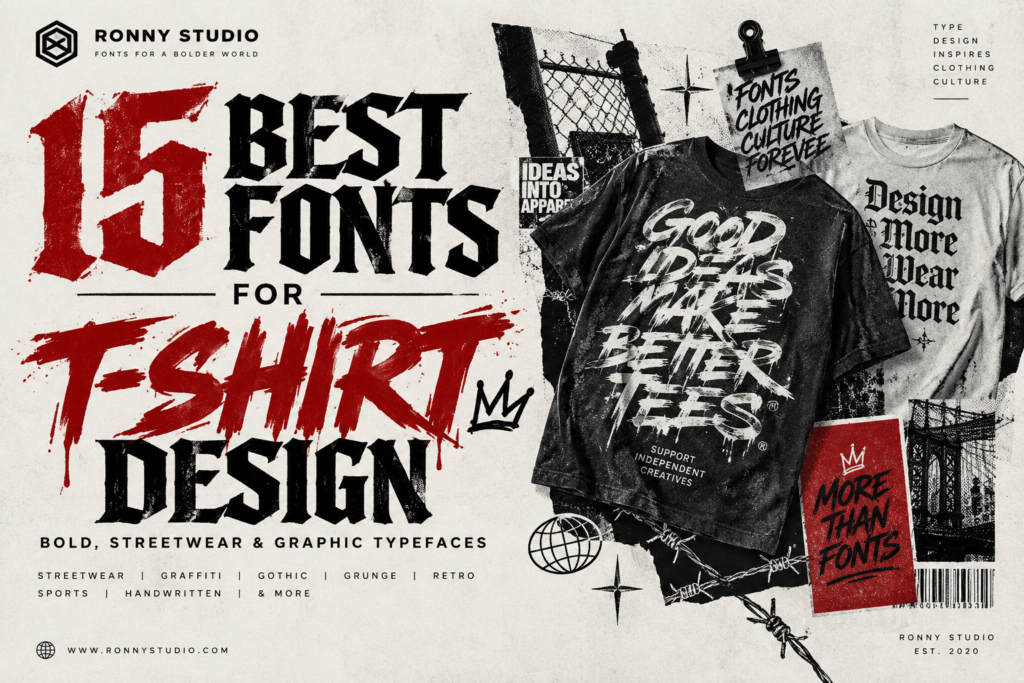
A great t-shirt design starts with a strong concept, but typography is often what makes the design truly stand out. The right font can turn a simple phrase into a powerful graphic, give a clothing brand its personality, and make a t-shirt instantly recognizable.
Whether you’re designing for a streetwear brand, skate brand, music merch, vintage clothing, or a limited-edition apparel collection, choosing the right typeface can make a huge difference.
Unlike fonts used for body text or traditional branding, t-shirt typography often needs to be bold, expressive, and easy to recognize from a distance.
In this article, we’ve put together 15 font styles that work especially well for t-shirt design, from aggressive display fonts and graffiti lettering to retro, gothic, grunge, and modern streetwear styles.
Before choosing a typeface, it’s important to understand what makes a font suitable for apparel design.
A good t-shirt font should have a strong visual personality while remaining readable enough to communicate the message of the design.
Here are some characteristics to look for:
The best choice ultimately depends on the aesthetic you’re trying to create.
Bold display fonts are one of the safest choices for t-shirt graphics.
Their heavy letterforms create an immediate visual impact and work particularly well for short phrases, slogans, names, and large typography-based designs.
Try using a bold display font for phrases such as:
NO RULES
STAY WILD
BUILT DIFFERENT
NEVER LOOK BACK
Large typography combined with a simple graphic can already create a strong apparel design.
Graffiti-inspired fonts are perfect for streetwear, skate apparel, urban brands, and youth-oriented clothing.
Their expressive shapes can make a design feel energetic and rebellious without requiring complicated illustrations.
Graffiti fonts work especially well when combined with:
For an authentic streetwear look, don’t be afraid to experiment with overlapping text and irregular positioning.
Gothic fonts continue to be extremely popular in modern apparel design.
Although blackletter typography has historical roots, contemporary designers frequently combine it with skull graphics, motorcycles, tattoos, metal aesthetics, and streetwear branding.
A gothic typeface can instantly give a t-shirt a dark, premium, and rebellious character.
It’s particularly effective for:
Front chest logos
Large back prints
Band merchandise
Motorcycle apparel
Tattoo-inspired graphics
If your design needs a rough, dirty, or distressed appearance, grunge fonts are an excellent option.
These fonts work naturally with vintage textures, worn prints, photocopy effects, scratches, paint splatters, and distressed illustrations.
Instead of making the font perfectly clean, the imperfections become part of the visual identity.
This makes grunge typography especially useful for:
Retro typography is another great direction for apparel.
Depending on the typeface, you can create aesthetics inspired by the 70s, 80s, or 90s.
Retro fonts work particularly well with curved lettering, bold colors, badges, vintage illustrations, and old-school print effects.
For example, a simple phrase can become much more interesting when placed inside a vintage badge or circular emblem.
For aggressive apparel designs, punk and hardcore-inspired fonts are hard to beat.
These typefaces often feature irregular shapes, sharp edges, distorted lettering, and chaotic compositions.
They’re ideal for:
Punk bands
Hardcore bands
Skate brands
Alternative clothing
Music merchandise
Combine the typography with photocopy textures, torn paper, tape, and high-contrast graphics for a convincing DIY aesthetic.
Not every t-shirt needs an aggressive typeface.
Handwritten display fonts can create a more personal and artistic appearance.
They’re particularly useful for lifestyle brands, creative merchandise, casual apparel, and designs that need a human touch.
Pairing a handwritten font with a clean sans serif can also create a strong typography combination.
Condensed fonts are extremely useful when you need large typography but have limited space.
Because the letters are narrower, you can fit longer words or phrases into a relatively small area while maintaining a bold appearance.
They’re especially useful for:
Sports-inspired fonts are perfect for creating a classic team or college aesthetic.
Think large numbers, curved text, varsity lettering, badges, and oversized back prints.
This style works well for:
College-inspired clothing
Sportswear
Baseball-inspired designs
Streetwear collections
Brush typography adds movement and energy to a design.
The imperfect strokes make the lettering feel handmade rather than digitally constructed.
Brush fonts are particularly effective for:
They can also be combined with clean typography to create contrast.
Distressed fonts are designed to look worn, printed, scratched, or aged.
They’re perfect when you want your apparel design to feel like it has been around for years.
A useful technique is combining distressed typography with a vintage illustration and limited-color printing.
The result can feel much more authentic than simply applying a generic texture over a clean font.
Sometimes the best font is one that doesn’t fit neatly into a category.
Experimental display fonts can feature unusual proportions, strange curves, distorted letters, futuristic shapes, or unexpected details.
These fonts are ideal when the typography itself needs to become the main graphic element.
For fashion and independent clothing brands, this can be a powerful way to create something more recognizable.
Modern apparel design has also brought renewed interest in futuristic and Y2K-inspired typography.
These fonts often feature:
They’re perfect for technology-inspired streetwear, gaming apparel, futuristic fashion, and modern graphic collections.
After exploring gothic and tattoo typography in our previous article, tattoo-inspired fonts are another excellent option for apparel.
Ornamental lettering, blackletter forms, script typography, and traditional tattoo aesthetics can translate extremely well onto t-shirts.
They’re especially effective when combined with:
Roses
Daggers
Skulls
Snakes
Eagles
Traditional tattoo ornaments
The key is keeping the composition balanced so the typography doesn’t compete with the illustration.
Finally, some of the most effective apparel designs use fonts that feel almost custom-made.
These fonts don’t necessarily belong to one specific category. Instead, they have distinctive letterforms that make a wordmark or phrase feel unique.
This is especially valuable for clothing brands.
A recognizable typeface can become part of the brand’s visual identity, allowing customers to associate a particular lettering style with the brand itself.
With thousands of fonts available, choosing one can be overwhelming.
A simple way to narrow down your options is to start with the personality of the brand.
Ask yourself:
Is the brand aggressive or minimal?
Is it vintage or futuristic?
Is it playful or serious?
Is the design aimed at streetwear, music, skate, fashion, or lifestyle?
Once you know the visual direction, choosing a font becomes much easier.
For example:
| T-Shirt Style | Font Direction |
|---|---|
| Streetwear | Graffiti / Bold Display |
| Punk | Distressed / Hardcore |
| Metal | Gothic / Blackletter |
| Skate | Brush / Graffiti |
| Vintage | Retro / Distressed |
| Sportswear | Varsity / Athletic |
| Fashion | Experimental / Display |
| Tattoo | Gothic / Script |
| Futuristic | Geometric / Y2K |
If you’re designing t-shirts for a clothing brand or selling merchandise, font licensing is extremely important.
A font that is free for personal projects isn’t necessarily free for commercial products.
Before using a typeface on merchandise, always check whether the license allows commercial use, physical products, apparel, logos, and client work.
If you’re looking for professionally designed fonts with commercial licensing options, explore the font collection at Ronny Studio.
Premium fonts for designers, apparel brands, logos, merchandise, posters, and more.
👉 Explore the collection at Ronny Studio:
https://ronnystudio.com/
The right font can completely change the personality of a t-shirt.
A simple phrase can become bold and aggressive with a hardcore typeface, nostalgic with a retro font, rebellious with graffiti lettering, or premium with a carefully designed gothic display font.
The important thing isn’t simply choosing the most eye-catching font.
It’s choosing the font that fits the story you’re trying to tell.
Whether you’re creating a new streetwear collection, designing band merchandise, launching a clothing brand, or simply experimenting with typography, the right typeface can turn an ordinary t-shirt into something people actually want to wear.
Good design starts with good typography.
And sometimes, the right font is the difference between a shirt that gets noticed and one that gets ignored.