
**Premium Fonts for Logos, Posters, Branding & More — Start Creating.**
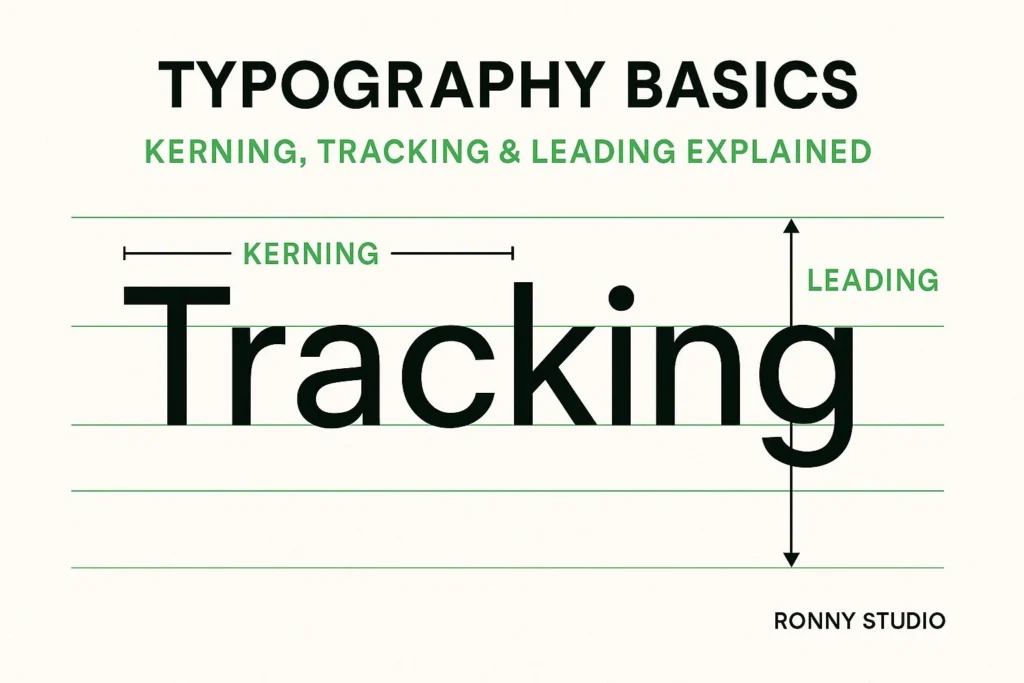
Good typography isn’t only about choosing a beautiful font — it’s about how letters live together.
Spacing defines rhythm, readability, and the overall feeling of your design.
Even a perfect font can look wrong if the spacing feels uneven or tight.
In typography, three key settings control this balance: kerning, tracking, and leading. Let’s go through each one and see how they can instantly make your work look more professional.
Kerning adjusts the space between specific letter pairs.
Some letters (like A and V) naturally create big gaps that need closing.
Proper kerning makes words look smooth and evenly spaced.
Without kerning, even a great logo can feel off.
With kerning, every letter connects visually, guiding the reader’s eyes naturally.
Pro Tip: Zoom out from your design — if a word looks uneven from a distance, tweak the kerning.
While kerning focuses on pairs, tracking affects spacing across an entire word or paragraph.
Adding more tracking creates a calm, elegant feel.
Reducing it makes the text tighter, louder, and more compact.
For example, luxury brands often use wider tracking to feel high-end.
Meanwhile, streetwear and metal logos (like Dawnee or Overals) usually use tight tracking for a bold, aggressive style.
Quick rule:
Headlines → slightly tighter tracking
Paragraphs → neutral or slightly wider tracking
Leading (pronounced led-ding) is the vertical distance between lines of text.
If lines are too close, text feels cramped.
Too far apart, it looks disconnected.
A good starting point: set leading around 120–140% of the font size.
So if your text is 16pt, try a leading between 19–22pt.
This gives enough breathing room for readers while keeping your layout tidy.
Typography spacing also affects emotion:
| Style | Emotion | Use |
|---|---|---|
| Tight spacing | Bold, powerful | Streetwear, posters, metal fonts |
| Wide spacing | Calm, elegant | Fashion, minimalist branding |
| Balanced spacing | Neutral, readable | Websites, blogs |
Your spacing choice should match your message.
Fonts like Thiskuy and Crazy Blocks feel energetic with tight tracking, while fonts like Dawnee need careful kerning to keep the chaos controlled.
Typography lives in the space between letters.
Mastering kerning, tracking, and leading will instantly make your text cleaner and more professional.
It’s not about rules — it’s about rhythm.
Once you train your eyes to see spacing, you’ll design with more precision and confidence.
CTA: Explore fonts built with professional spacing and strong character → ronnystudio.com/fonts
One Comment
tox23
Its like you read my mind! You seem to know so much about this, like you wrote
the book in it or something. I think that you could do with a few pics to drive
the message home a little bit, but other than that, this is great blog.
A great read. I’ll certainly be back.
Here is my page … tox23
Comments are closed.